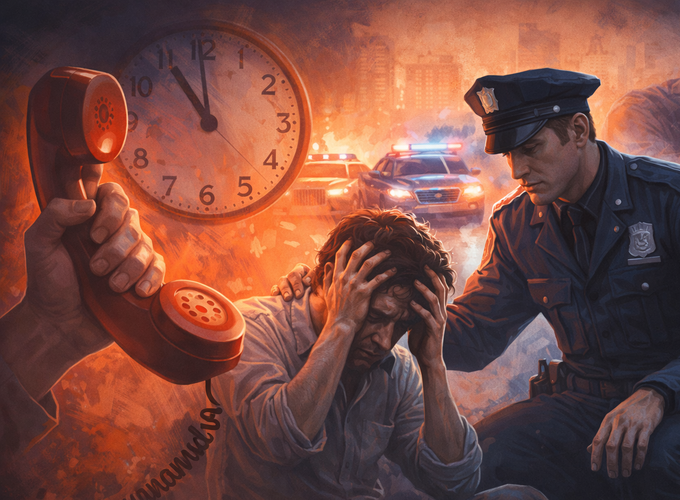
If you ask most people why police officers spend so much time responding to mental health crises, they’ll probably mention “deinstitutionalization” - the mass closure of state mental hospitals starting in the 1960s. But what if that story is incomplete?
A fascinating new article by David Thacher in Policing and Society argues that the police role in mental health crisis response actually emerged much earlier - and for entirely different reasons. Understanding this history, Thacher suggests, is crucial if we want to fix the problems we face today.
📞 The Invention of Urgency
Before the 1930s and 1940s, if you wanted to summon a police officer, your main option was to “run into the street and yell.” Police work was structured around scheduled patrols with fixed routes and regular check-ins at call boxes. Emergencies happened, but responding to them was exceptional, not central to the job.
Then came the telephone and the radio-equipped patrol car.
Suddenly, anyone could contact the police and expect an immediate response to whatever they considered an emergency. This fundamentally transformed what police were expected to do:
“Police work involves no continuances and no appointments. Its temporal structure is throughout of the ‘as soon as I can get to it’ norm, and its scheduling derives from the natural fall of events and not from any externally imposed order.”
That’s Egon Bittner’s famous observation from the 1970s. But Thacher shows that even Bittner didn’t fully appreciate how recently this had emerged.
🔄 From Paperwork to Crisis Response
In the early 1900s, police involvement with mental illness looked completely different:
Then: Officers mainly served as “adjuncts to the courts” - transporting patients to hospitals after a judge had already ordered commitment. It was ministerial work, scheduled and routine. One major study in the mid-1930s found that nearly two-thirds of hospital commitments involved police in this limited way.
Now: Officers are dispatched to homes and streets to manage urgent crises in real-time, often making complex judgment calls about what to do with little guidance or support. Studies consistently find that roughly two-thirds of police incidents related to mental illness begin with a 911 call.
The shift was dramatic. Where early 20th century studies described police encounters with mentally ill people “wandering in the streets” during routine patrols, studies from the 1950s onward describe “frantic family members or neighbours” using the telephone to summon officers to mental health crises, often in private homes.
⏰ This Happened Before Deinstitutionalization
Thacher shows that police were already playing a major role in mental health crisis response by the 1950s - before state hospital populations began to fall and before the legal and policy changes associated with deinstitutionalization.
“The large role of the police in today’s mental health system did not result from deinstitutionalization: It was already in place by the 1950s, when mental hospital populations were at their peak.”
This matters because it suggests that simply rebuilding the mental health treatment system won’t, by itself, solve the problems with police-mental health encounters. The issue isn’t just a lack of hospital beds - it’s the temporal structure of the work itself.
🤷 Psychiatry Couldn’t Help (Much)
As police struggled with their new responsibilities, they naturally turned to mental health professionals for guidance. The result? A mismatch.
Psychiatry was (and largely still is) focused on diagnosis, treatment, and long-term care - work conducted in clinics and offices on scheduled appointments. Managing an agitated person in their living room at 2 AM? That was outside their wheelhouse.
Officers found trainings “interesting but detached from the realities of the situations they were expected to handle.” One psychologist who developed police training admitted the content was “too intellectualized and devoid of significant relevance for patrolmen.”
The influential 1954 handbook How to Recognize and Handle Abnormal People - used for decades in police academies - even cited techniques from mental hospital attendants rather than psychiatrists. And some of that advice (leather cuffs, straight-jackets, hot and cold baths) was obviously unsuited to fieldwork.
Meanwhile, psychiatrists themselves largely avoided emergency work. As one health officer reported in 1962:
“Few psychiatrists ever have had experience in answering emergency calls in the home, on the street, or any place else. Some vehemently contend that there is no such thing as a psychiatric emergency.”
🎯 What Actually Works
So what did work? Thacher highlights Bittner’s fieldwork with the San Francisco Police Department in the 1960s, which focused on individual officers who had become skilled at “psychiatric first aid.”
These officers rarely took people to the hospital. Instead, they:
- Found responsible caretakers - relatives, neighbors, hotel clerks, landlords - who could keep an eye on someone
- Relocated people from contexts where they were disruptive to contexts where they wouldn’t be
- Restored calm in the moment through patient, matter-of-fact conversation
The goal wasn’t treatment of the underlying condition(s), but resolving the immediate crisis - “imposing provisional solutions upon problems” in the here-and-now.
“There is no sustained concern for these persons. Whenever certain known persons come to the attention of officers, it is said that they are ‘acting up again’. The avoidance of a sustained concern and attention is part of the official posture of the police.”
One SFPD officer, Raymond Hansen, became so skilled at this work that Bittner remarked: “I have often thought that it would not be a bad idea to have psychiatrists travel with him to learn how he does it.”
💡 What This Means Today
Thacher’s history has real implications for current reform efforts:
For alternative response programs: Simply sending social workers or counselors instead of police doesn’t solve the underlying problem if we don’t understand what the job actually requires. As one recent analysis put it: “Conversations about behavioral health crisis response typically center on the question of whether that response should involve law enforcement or someone else” but “rarely address the fundamental question of what skills and capacities are truly needed in this role.”
For police training: Decades of importing “mental health expertise” may have missed the point. The skills officers need aren’t primarily about psychiatric diagnosis - they’re about managing urgent situations in complex environments. We might learn more by studying what the best officers already do than by importing techniques from clinicians who work in entirely different contexts.
For all of us: The expectation that someone will show up immediately when we call about an emergency is historically novel. Police became the institution that fulfills that expectation largely by default. If we want to change that, we need to grapple with the temporal structure of crisis response - not just the categories of problems we’re responding to.
🔮 The Bottom Line
The police role in mental health crisis response wasn’t created by deinstitutionalization. It was created by the telephone and the patrol car - by our collective expectation that someone will respond right now when we perceive an emergency.
Understanding this history won’t solve our current problems by itself. But it might help us ask better questions about what we’re actually trying to accomplish - and what skills and institutions we need to accomplish it.
David Thacher’s paper “The invention of urgency: the transformation of the police role in society’s response to mental illness, 1900-1970” is published in Policing and Society and is available open access here.